
From roof to resource: How Waver Wampool farms are turning rainfall into resilience
WCRT Farming Officer, Tash Pearson has been working with farmers in the northwest of the county, on the Waver Wampool Farming Futures project. Now in its third year, the project's main aim is to bring food businesses and processors together to support the adoption of sustainable farm practices which improve our water quality and help to futureproof farm businesses.
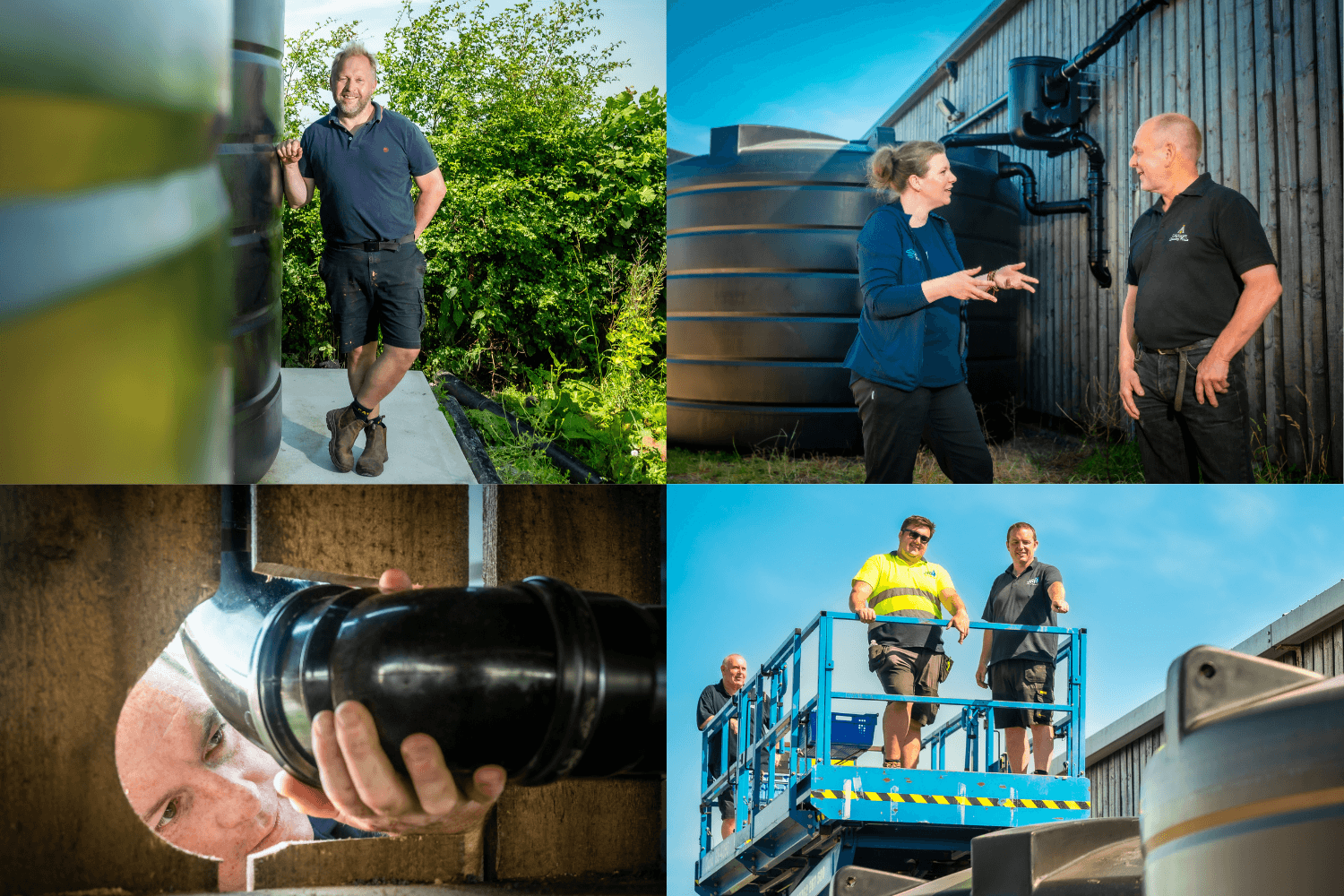
Tasha chatting to a participating farmer top right during the rainwater harvesting installation process
Finding that sweet spot
It's no secret that farmers are getting a raw deal lately. Trying to make a five-minute plan, let alone a five-year plan, is becoming increasingly difficult given the constant changes with government policy, grant options, climate, feed, fertiliser and volatile milk prices. The list goes on, and farmers are caught in the middle of an ongoing global shift in how the agricultural sector is being reshaped.
The overarching aim of this project is to do what farmers don't have time to do: identify sensible, viable options, secure funding, and implement sustainable practices that embrace the changes coming down the road.
One of the most important parts of my job (and the most enjoyable) is to get out there and build relationships with land managers, discuss options and listen to what will help them. Only then, can we really help to deliver the right solutions, in the right place, that will make a difference from the ground up and ensure lasting, positive change.
Bethany, my colleague in the neighbouring catchment, actually brought the idea of rainwater harvesting on farms to my attention as she has organised a local farmer meeting which, being inherently nosy, I couldn't resist gatecrashing. It was there that I met Michael Jordon (no, not that one), from JRH Water Management and I was inspired by the multiple benefits retrofitting these systems could have. The stars aligned and I got to work putting together a bid to secure funding for an exciting new project that perfectly sits in that sweet spot, a win for farm businesses and our environment.
Collaboration is key - WRAP
My role is funded by the Waste and Resources Action Programme (WRAP) and whilst the name may be a bit of a tongue twister, this international NGO has been instrumental in supporting us to deliver this valuable work. My project, The Waver Wampool Farming Futures, is one of WRAP's Catchment Action Projects (CAP) that are funded by suppliers and processers who are working to transform the traditional, linear food supply chain into a circular 'farm to fork' approach. By bringing businesses together, we can ensure accountability, inspire re-investment into farm businesses and facilitate sustainable change. Collaboration is absolutely key at every stage, after all food security concerns us all.
Last year, WRAP introduced a new funding stream, the 'Nature Based Solutions' fund, which enabled us to secure £107k to deliver nine rainwater harvesting systems on farms. While rainwater harvesting on farms is not a new concept, the retrofitting of so many systems in a catchment is a first and I'm thrilled to be a part of it.
Once we learnt about the fund, we were straight out visiting farmers, to discuss the benefits and offer the opportunity. This was actually the easiest part of the project as it was a very easy sell, reducing reliance on mains water and pressure on borehole abstraction and ensuring a consistent and steady supply of water. What's not to love!? Farmers and our contractors, JRH, were quickly primed and ready. Now we just needed to complete the less exciting task: the paperwork.
Saving for a dry day: creating stability and consistency in the face of climate change
It feels like climate change has been discussed and debated so long, there's a risk of it becoming white noise for many. But in our lifetime there has been a clear shift, and increasingly we are all starting to experience it on a personal level. Few of us don't know someone who has been affected by flooding in their community, or who has had to cope with the stress of heat waves. Living in a relatively temperate climate, we have been fortunate for a long time to experience these impacts mainly through the news or in classrooms, but climate change is now becoming a lived experience. And the evidence suggests things are only set to worsen.
Capturing rainwater on farm is a fantastic and scalable way of ensuring farmers are prepared and ready to cope with these increasingly dramatic weather episodes. The installation of so many rainwater harvesting systems in the same catchment will help to reduce local flood risk in periods of heavy rain whilst also, reducing impacts in periods of drought. As a free resource, farmers are also able to reduce their ever-increasing water bills which helps relieve the financial pressures which we know many are experiencing.
I could go on all day about the benefits of capturing rainwater, but I'll resist and just mention two. First, livestock have been proven to perform better on - and prefer - rainwater over mains water due to its softness and lack of additives. Second, harvested rainwater has a neutral pH ideal for crop growth, which improves the efficacy of agricultural sprays, enhances soil structure and reduces soil erosion. Diverting clean roof water away from slurry stores also reduces farmyard surface runoff and improves slurry management. Reducing borehole abstraction in periods of dry weather, helps protect our aquifers and ecosystems. It's a win, win, win. This 'no strings attached' chemical-free and sustainable water supply will prove increasingly valuable to the many farmers who heavily rely on water to optimise production, keep their livestock, crops and soils happy and healthy whilst also helping improve the health of our local watercourses and ecosystems.
Rain, rain, don't go away...
As part of the project, we have committed to three years of monitoring and have been rushing out to farms every time it rains heavily enough, to sample farmyard surface runoff and record storage and usage on each farm. Collecting anywhere near enough baseline data to ensure statistical significance has ended up being a real challenge as, thanks to Murphy's Law, opportunities to visit farmyards when there was enough surface water to measure have been few and far between. As a result, we don't yet have the most accurate snapshot.
Another challenge we encountered when planning the monitoring of rainwater usage was that many of the farms didn't actually require pumps, which meant we weren't able to fit water meters and had to ask farmers to manually record their usage (which understandably, no one was excited about). Thankfully, to avoid putting extra burden on farmers, our contractors discovered a monitoring device that could send information directly to an app, so we are now able to record usage from the comfort of our desks, not only reducing our organisational carbon footprint but also saving time and fuel. This is relatively untested technology in the UK, so it should prove to be a very interesting and useful trial.
What's next?
The systems were all installed in July and the tanks are already filling. It's been a wonderfully smooth project to deliver with so many benefits all round but only time will help us identify the biggest gains in the short and long term. We are planning to bring together farmers with the systems with others who are interested in November, to discuss their thoughts and lessons learnt over a pie and a pint. It would be fantastic to secure further funding for the Waver Wampool catchment and continue delivering rainwater harvesting systems and similar mutually beneficial projects to bolster farm businesses and protect and improve our valuable watercourses in preparation for the challenging times ahead.
We were chuffed to be asked to feature in the Agriculture and Horticulture Development Board’s (AHDB) ‘Ag Show’ and you can learn more about our project and other farm related news.
Episode 1: Could harvesting rainwater on …–Agonomics – Apple Podcasts
Find out more about Tash’s project in the Waver Wampool catchment. Rivers Waver & Wampool — West Cumbria Rivers Trust
Read the press release about this project.